Tamás Kisantal (1975) teaches literature at the University of Pécs. His fields of researchs include narratology, the problems of historical narrative, the representation of the Holocaust etc. His monographs: Túlélő történetek. (Surviving Stories) Kijárat Kiadó, Budapest, 2009.; „...egy tömegmészárlásról mi értelmes dolgot lehetne elmondani?" („There is Nothing Intelligent to Say about a Massacre") University of Jyvaskyla, Jyvaskyla, 2006.
- Bauman, Zygmunt: Modernity and the Holocaust. Polity Press, Cambridge, 2005. (1989.)
- Bendix, John: Facing Hitler. German Responses to Downfall. German Politics and Society, 25. (2007/1.) 70-89.
- Benjamin, Walter: The Work of Art in the Age of Mechanical Reproduction (1936.) http://www.marxists.org/reference/subject/philosophy/works/ge/benjamin.htm
- Bloch, Marc: The Royal Touch: Sacred Monarchy and Scrofula in England and France. Routledge, London, 1973. (1924.)
- Brown, Peter: The Cult of the Saints. Its Rise and Function in Latin Christianity. Chicago University Press, Chicago, 1981.
- Chaplin, Charlie: My Autobiography. Simon & Schuster, New York, 1964.
- David Bordwell - Kristin Thompson: Film Art: An Introduction. Fifth Edition. The McGraw-Hill Companies, New York, 1997.
- Elsaesser, Thomas: Myth as the Phantasmagoria of History. H. J. Syberberg, Cinema and Representation. New German Critique, 24-25. (1981/Autumn - 1982/Winter)108-154.
- Forever in the Shadow of Hitler. Original Documents of the Historikerstreit, the Controversy Concerning the Singularity of Holocaust. Humanities Press, New Jersey, 1993.
- Friedländer, Saul (ed.): Probing the Limit of Representation. Nazism and the „Final Solution". Harvard University Press, Cambridge, 1992.
- Gilman, Sande L.: Is Life Beautiful? Can the Shoah Be Funny? Some Thoughts on Recent and Older Films. Critical Inquiry, 26. (2000/2.) 279-308.
- Hartman, Geoffrey (ed.): Bitburg in Moral and Political Perspective. Indiana University Press, Bloomington, 1986.
- Hill, Amelia: Coming to Your Screen Soon: Hitler, the Movie. The Observer, July 21. 2002. http://www.guardian.co.uk/uk/2002/jul/21/world.germany
- Jameson, Fredrick: "In the destructive element immerse": Hans-Jürgen Syberberg and Cultural Revolution. In: Jameson: Signatures of the Visible. Routledge, New York & London, 1990. 63-81.
- Kantorowitz, Ernst: The King's Two Bodies. A Study in Medieval Political Theology. Princeton University Press, Princeton, 1957.
- Kershaw, Ian: The 'Hitler Myth' Image and the Reality in the Third Reich. Oxford University Press, Oxford, 1987.
- Kershaw, Ian: The Human Hitler. The Guardian, September 17. 2004. http://www.guardian.co.uk/film/2004/sep/17/germany
- Kopenick, Lutz: Face/Off. Hitler and the Weimar Photography. In: Finney, Gail (ed.): Visual Culture in Twentieth-century Germany. Text as Spectacle. Indiana University Press, Bloomington, 2006. 214-234.
- Kracauer, Siegfried: From Caligari to Hitler. A Psychological History of the German Film. Princeton University Press, Princeton, 1966.
- Leiser, Erwin: Nazi Cinema. Transl.: Gertrud Mander and David Wilson. Macmillan Publishing Co., New York, 1974.
- Lukacs, John: The Hitler of History. Random House, New York, 1997.
- Macfarlane, Daniel: Projecting Hitler. Representations of Adolf Hitler in English-language Films. http://library2.usask.ca/theses/available/etd-02272005-152739/unrestricted/macfarlanethesisfinaldraft.pdf
- Mason, Tim: Intention and Explanation. In: Hirschfeld, Gerhard - Kettenacker, Lothar: The ‘Führer State': Myth and Reality. Studies on the Structure and Politics of the Third Reich. Klett-Kotta, Stuttgart, 1981. 23-40.
- Mintz, Alan: Popular Culture and the Shaping of Holocaust Memory in America. University of Washington, Seattle and London, 2001.
- Renschler, Eric: The Fascination of a Fake: The Hitler Diaries. New German Critique, 90. (2003/Autumn) 177-192.
- Rosenfeld, Alvin H.: Imagining Hitler. Indiana University Press, Bloomington, 1985.
- Rosenfeld, Gavriel D.: The World Hitler Never Made. Alternate History and the Memory of Nazism. Cambridge University Press, Cambridge, 2005.
- Sontag, Susan: Fascinating Fascism. In: Sontag: Under the Sign of Saturn. Essays. Farrar, Straus and Giroux, New York, 2002. (1980.) 73-108.
- Sontag, Susan: Syberberg's Hiter. In: Sontag 2002. (1980.) 137-168.
- Sussman, Peter: Interview in Judaism - The Jewis Website: http://www.aish.com/jw/s/48891317.html
- Waite, Robert G. L.: The Psychopathic God: Adolf Hitler. Da Capo Press, New York, 1993.
- Weinberg, David: Approaches to the Study of Film in the Third Reich: A Critical Appraisal. Journal of Contemporary History, 19. (1984/1.) 105-126.
- Welch, David: Propaganda and the German Cinema 1933-1945. I. B. Tauris, London and New York,
2001.
The essay analyses the concept of "cult film" in a way that diverges from customary approaches; it examines the connection between real, historical cults and their representation in cinema. The example of the essay is the cult of the leader of the Nazi Party, Adolf Hitler and his filmic representations. It shortly surveys the history of pictorial representations of Hitler from the photos of Heinrich Hoffmann through the famous propagandistic films of Leni Riefenstahl to the postwar filmic representations. The essay focuses on two significant Hitler-films of the recent past: the American mini-series, The Rise of the Evil (2003) and the German film, Der Untergang (2004).
To make a serious film about Hitler has to be dangerous – otherwise it wouldn’t be honest.
(Hans-Jürgen Syberberg)
In this essay I approach the concept of „cult film” in a way that diverges from customary approaches. I will examine not the notion of cultic films or its various forms and mechanisms, but the connection between real, historical cults and their representation in cinema. In other words my use of the concept „cult” is not attached to certain films which are widely considered to have a „cultic status”, but I want to analyze the operations of historical or specifically ideological, political cults and their representations, especially in film, relying on a specific example functioning as a case-study. I hope this case-study may illuminate some deeper movements with reference to the creating of cults, focusing on the relation between cults and culture, especially cults and the historical knowledge of a given culture. [1]
If we want to analyze the function of historical cults and the forms or methods of the representation of these kinds of cults in films, it seems to be obvious to examine the dictators’ cult of personality as a phenomenon, which is artificially upheld in the beginning but later on starts to have a life of its own. This cult is closely connected with the cult of kings and, going further, with the cult of saints, [2] but as a specific phenomenon of the 20th century it is a secularized and in some way intentionally upheld form. My study will analyze the cult of the leader of the Nazi Party, Adolf Hitler and his filmic representations. Dealing with Hitler from the viewpoint of cultic representations is almost self-evident, not only since his figure functions nowadays as the personification of the total dictatorships and the reign of terror, but because of his mythic afterlife as a symbol (of radical evil, of the absolute will to power etc.) that is detectable in our everyday life. His role in films is cultic too: the films about Hitler (or films in which Hitler appeared) are usually not necessarily cult films, but his role in these kinds of films is always so remarkable that it has often been acted by famous and significant stars, including Charlie Chaplin, Alec Guinness, Anthony Hopkins, Robert Carlyle and Bruno Ganz. As Alvin H. Rosenfeld noticed about Hitler’s popularity, „Hitler has not gone without a good deal of posthumous attention, in other words. Go to the movies and you will see him. Look at the popular bookracks and you can’t miss him. There is a growth industry in Hitler picture books, biographies, films, fiction, other assorted memorabilia, tokens and trinkets that symbolize the Nazi period and hold it steadily before us”. [3] Although Rosenfeld’s observation has originated in the context of the 80s, it has the same actuality at the beginning of the 21st century, since Hitler and the age of Nazism is still one of the most popular themes of historical and quasi-historical books, films, computer games etc. To find an answer to this ambivalent but undiminished popularity, we need a more profound historical and cultural investigation to analyze the main manifestations of this phenomenon as well as its political and cultural contexts. In this essay I will try to analyze only a small segment of the issue, the filmic representations of the Hitler-figure, in order to shed light upon the mechanisms of this cult in particular, and, from a wider, more general perspective, on the mechanisms of our culture and the fundamental characteristics of our attitude to our recent past.
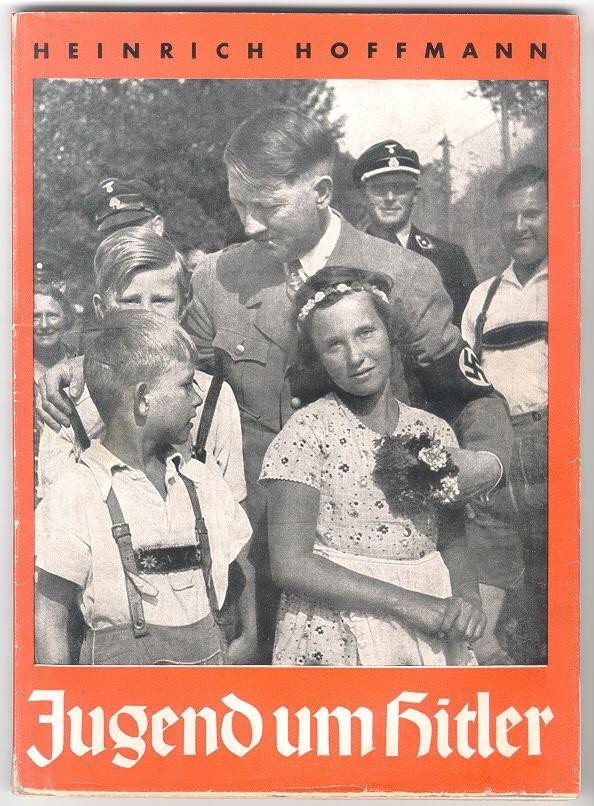
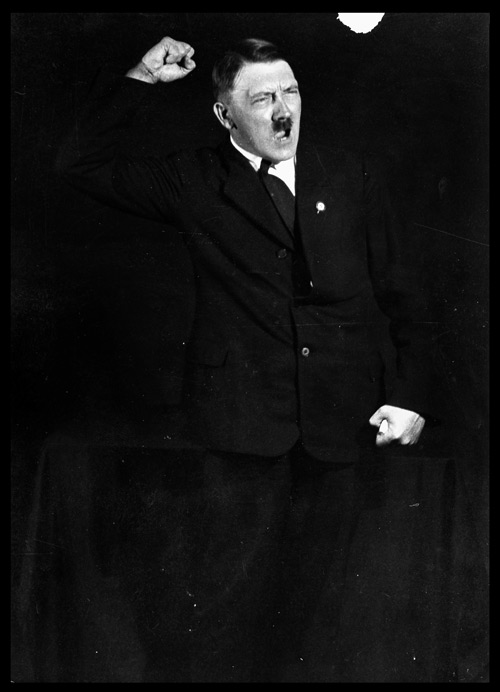
As Ian Kershaw has pointed out in his pioneering study that the cult of Hitler, or „the Hitler-myth,” as he called it, had come into being as a consequence, on the one hand, of special historical circumstances, and on the other, as a result of a consciously established Fuehrer-image. [4] This image was built partly by Hitler and his surroundings themselves. From the early years of his political career Hitler devoted a great care to his appearance, and with help of his photographer Heinrich Hoffmann he had created a visual image type with which he referred to himself not so much as a real man but as a leader of a party or a nation. He carefully selected the photos allowed to be published, the positions and situations in which he had been photographed, and he was represented in these photo portraits in very rhetorical and didactic poses, emphasizing his power and prestige or his ‘human face’ as the ‘loving father of the nation’. [5] Hoffmann published these photos in postcards and later he compiled them into concept albums with effective titles, like The Hitler Nobody Knows, Hitler in his Mountains, Youth around Hitler etc., which were published by a special publishing house, Verlag für Zeitgeschichte (Modern Times Publisher), and became real „bestsellers” of the Nazi Period. Hitler also paid a great attention to his speech-style, his intonation and gestures, and he took care of his ‘public reputation’: he didn’t wear glasses in public; he was unmarried (he married Eva Braun only on his last days in the bunker when the wider public could not see him anymore) and so on. He represented himself with these procedures as the powerful leader who lives merely for his nation and who is both powerful and superhuman. [6]
|
Two „faces” of Hitler in the photos of Heinrich Hoffmann
|
Two „faces” of Hitler in the photos of Heinrich Hoffmann
|
Naturally Hitler’s cult of personality was not only his own creation but an outcome of a well-established propagandistic work, in which film played a specific role. As many studies have already disclosed, films performed central function in the Third Reich, because Joseph Goebbels (Minister of Public Entertainment and Propaganda) and Hitler were film fans themselves, and the minister ascribed an important task to the movie. [7] Most of the films that were made in and by Nazi Germany had simply an entertaining and escapist function, or to be more precise, these movies advocated the Nazi ideology and value system through simple and amusing stories. Only one-sixth of the thousand plus films that had been made between 1933 and 1945 had direct political and propagandistic content. [8] The most famous and ill famed of these propaganda films were the well-known films of Leni Riefenstahl, Triumph of the Will (Triumph des Willens, 1935) and Olympia (1938, in two parts). It is not necessary to point out the significant propagandistic role of Riefenstahl’s Triumph, which through the presentation of the 1934 Nazi Party Rally in Nuremberg represents the Party and its leader as an inheritor of an imagined mythical German heroic ideal. Hitler performs a leading role in the film; he is the „protagonist”, the „hero” who is simultaneously the director of this ceremony and the leader or the „director” of the whole nation. The filmic representation of Hitler is highly sophisticated and idealized; the camera usually shows him from beneath (from „the spectator point of view”) pointing out his absolute highness and superiority, and the marching masses are shown from above, from the viewpoint of Hitler (or, as the film suggests, of God). [9] The introducing pictures of the film strongly represent the mythic and cultic status of Hitler. The first titles of the film sketch the circumstances of the event: „On the 5th of September 1934, 20 years after the outbreak of World War, 16 years after the beginning of Germany’s suffering, 19 months after the beginning of the German rebirth, Adolf Hitler flew again to Nuremberg to review his faithful followers”. The text puts this unique historical event into a wider narrative context: it connects the mythic story of the fall and resurrection of a collective entity, Germany, to the concrete story about the messianic leader who visits his adherents. After this text the camera shows the airplane of Hitler and the clouds, which is followed by a shot showing the plane coming closer to Nuremberg, the castle, some churches, and finally the little people on the ground flocking together to see their Fuehrer. The god-like leader arrives to his faithful followers – as this scene presents the event. After two hours during which one can attend the whole ceremony, the orations of Hitler and other heads of Party, the final scenes of the film do not close this unique event, since one cannot see the end of the gathering, nor the departure of Hitler from Nuremberg. The closing shots depict the culmination of the Congress. One can see the masses continuously marching and singing under the Swastika, while in the last scene the image of marching soldiers slowly transits into the image of the clouds, suggesting eternity and alluding to the sacral nature of this event.

Scene from the Thriumph
The films of Riefenstahl, especially the Triumph, had not only expressed the cult but had become cultic in themselves because of two reasons. First of all this is a very rare instance of an explicitly and extremely ideological artwork that is able to function in itself as a work of art, and not only as a piece of a specific historical period or as political propagandistic film. The Triumph as a monstrous Wagnerian Gesamstkunstwerk is a spectacular example of the Nazi aesthetics that converted rituals and ceremonies into theatrical and filmic events. Sigfried Kracauer pointed out in his classic film history that the Triumph not only recorded the congress and its ceremonies, but the congress itself was directed as a film where Hitler performed both the priest of the ritual and the star of the movie. [10] The assertions of Leni Riefenstahl, when defending her film and her questionable role during the Nazi period, could be considered as true from this point of view. She said that the Triumph „doesn’t contain a single reconstructed scene. Everything in it is real. And there is no tendentious commentary for the simple reason that the film has no commentary at all. It is history. A purely historical film”. [11] As we see, the film is not only history, but an ideologized version of it, too. The statement, however, is true in the sense of the Nazi intention to change the political events into ritual and theatrical performances. Riefenstahl’s film can be considered as a perfect and extremely dangerous manifestation of the observation of Walter Benjamin, namely that the „logical result of Fascism is the introduction of aesthetics into political life”. [12]
On the other hand the films of Riefenstahl have enjoyed cultic status after the Nazi regime too. This status has become stronger due to the controversies about the personality of the directress and her personal responsibility in the Nazi regime. Her films caused a disturbing effect of the juxtaposition of great aesthetic and technical inventions and ethically questionable aims. This effect, and the strange (or, for this reason, interesting) character of the Nazi regime, which can be seen even now, retained and increased the cultic status of the propaganda works of Riefenstahl. To bring a recent example, in the Internet Movie Database one can see that the films of Riefenstahl are highly appreciated by the movie buffs. Triumph stands 7.8/10 after 5062 votes – as comparison, the most ill famed anti-Semitic Nazi propaganda film, Jud Süß (directed by Veit Harlan, 1940) stands 5.4/10 after 541 votes. The situation is more interesting on a closer examination. Significant part of the voters (31.1%) of Jud Süß considered it excellent and 24.4% thought it was awful, while in the case of Triumph the majority of users (31.7%) credited the film with 10 and 16% with 9. One could venture to say that most of the voters of Jud Süß are either sympathizers of the extremist anti-Semitic attitude or its opponents, while the case of the Triumph is more ambiguous, since the viewers watched it not so much ideologically than aesthetically (or perhaps „cultically”). [13]
In my view the cultic (or quasi-cultic) status of Riefenstahl’s film is also due to the fact that the cult of Hitler more or less survived World War II, and it continued to live after the fall of the Nazi regime. Under the statement the „cult of Hitler” I mean of course not only the ultra right wing or neo-Nazi worship of the Fuehrer, but mainly the strange cult of a mythic Hitler-figure who is not so much a real person but a kind of cultural function embodying our fears from and ambivalent feelings towards the past. To speak about Hitler as a „demon”, „devil” or „beast” undoubtedly is an oversimplification, because in this way he remains a secret (as the nature of the devil is mysterious), which we try to explain as we attempt to integrate his figure into our past and our history. The historical and artistic works about Hitler published after 1945 prove that the numberless books on him are not able to fully analyze and examine his personality and give a sufficient interpretation of his unbelievably successful career. As John Lukacs, comparing the Hitler of the historians with the historical Hitler, pointed out, the figure of Hitler and the historical approach to his personality and his actions are varied not only because of the progress of historiography or the revealing of new sources, but also because of the historical and cultural differences between the historians and their different intentions. [14] In other words, notwithstanding that we have many well known and countless lesser-known biographies about Hitler, our knowledge on his personality and motives remains imperfect and controversial.
This mysteriousness of his personality, on the one hand, ensues from the horrible character and the „negative greatness” of events connected to him (the Nazi regime, the Holocaust, World War II, etc.). On the other hand, however, it roots it the enigmatic character of his life itself. We have only scattered information about his youth, most of them coming from Hitler himself and the first part of his book Mein Kampf, this strikingly ideologically construed autobiography, in which facts were selected and combined from the later viewpoint of the Nazi leader and his intellectual „bildung”. Naturally, the lack of the sources about his youth generated some speculations and myths, like those about his Viennese years, his relationship to Jews, his legendary, and in all probability false journey to his sister to Liverpool. These stories appeared not only in historical or quasi-historical works but in literature and film, too; we could mention for example Beryl Bainbridge’s novel and the comic series of Grand Morrison and Steve Yeowell about Hitler’s journey in England (Young Adolf, 1979; The New Adventures of Hitler, 1989), George Tabori’s satirical drama about Hitler’s years in Vienna (Mein Kampf, 1997), Menno Meyjes’ film on the young Hitler in Munich (Max, 2002) or Norman Mailer’s novel on the infancy of the future dictator (The Castle in the Forest, 2007), etc.
The death of Hitler is similarly enigmatic. The circumstances of his suicide in the bunker had given rise to conjectures and controversies. The historical cause of these discussions is that the Soviet Army was the first that arrived at the scene and the events are known only from the reports of the Soviets. One of the first historical records about the death of Hitler was Hugh Trevor Roper’s The Last Days of Hitler (1947). The author, a subsequently famous historian, who at that time was an officer of the British Secret Intelligence Service, investigated circumstances of Hitler’s death on behalf of the government, described the events of the last days. But on the other hand, especially with the emotional and patriotic rhetoric of the book, he paradoxically contributed to the perpetuation of the Hitler-cult and the continuation of the myth about the monstrous and demonic leader who was both dreadful and sublime. [15]
The stories and speculations about the death of Hitler have lead to the emergence of the so-called „survival myth”, the legend about the fugitive Hitler whose suicide was only a hoax. During the 1950s and 1960s some sensationalistic articles appeared, in which self-proclaimed Hitler-hunters declared having found the hiding-place of Hitler. This myth manifested itself also in some popular artworks from films (They Saved Hitler’s Brain, 1963; He’s Alive – an episode of the cultic American TV show, The Twilight Zone, 1963 etc.) through novels (the most famous is The Portage to San Cristóbal of A. H., 1981by the philosopher and literary theorist George Steiner) to comic books (the most controversial was Walter Moers’ Adolf die Nazi-Sau [Adolph, The Nazi Pig], 1998-1999), not to mention the different versions of quasi-myths like, for example, Ira Levin’s novel about the cloning of Hitler by the other mythical Nazi villain, Dr. Mengele, Boys from Brazil (1976) and its film version (dir.: Franklin J. Schaffner, 1978). [16]
The works on Hitler’s youth and his last day (or survival) are only indications of the popularity of this theme that was noticeable already after the war and has been regaining strength since the 1970s (the years of the so-called „Hitler-wave”, from when the theme suddenly became more popular) until today. We could mention some other examples from the fake „Hitler-diaries” [17] to the scandal around Fuehrerwein (an Italian wine-collection featuring pictures of Hitler on the labels) [18] that point out the strange but undiminished interest in the figure of Hitler.
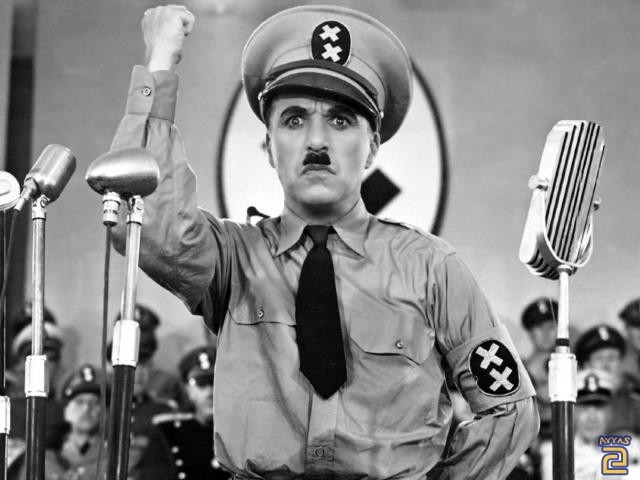
Chaplin as Adenoid Hinkel in The Great Dictator
The films about Hitler made after 1945 actually contributed to the survival of the Hitler-cult. It is important to mention that the variations and forms in which Hitler is portrayed in these films appeared already during the Nazi area. Historical or war films of the 1960s-1980s chiefly represent Hitler as the radical evil, but this evilness is paradoxically entailed with the greatness and the sublimity which was taken over from Nazi propaganda itself. The point, certainly, is not that the recent films on Hitler (or films in which Hitler is one of the characters) employ the propagandistic attitude of the past, but that the approach and representational methods come from this period or may be considered as an inverse version of past representations. Showing Hitler as a paradigmatic evil can be interpreted as an inverse version of the godlike representation of Riefenstahl and other propagandist artists. The case is similar in the satirical, humorous representation of the Fuehrer, whose origin can be traced back to the American anti-Nazi propaganda of 1940s. Soon after the outbreak of the war some comic representations of Hitler appeared in cinemas and in other popular forums, especially comic strips. The figure of Hitler had become the target of comic films in the early 1940s when the US had not drifted into the war yet, from the short slapstick comedies of Three Stooges (You Nazty Spy, 1940; I’ll Never Heil Again, 1941) to the remarkable movie of Charlie Chaplin (The Great Dictator, 1940). After 1941, when the USA had drifted in the war, some comical and satirical works were produced, including Ernst Lubitsch war spy-comedy (To Be or Not To Be, 1942) and anti-Nazi Disney films (Education for Death, Der Fuehrer’s Face, 1943), created with a more or less direct propagandistic aim. Obviously at stake in these comic versions was to make the enemy look ridiculous and show his dreadful character as pure appearance, behind which there is nothing more than a pure small-minded lust for power. Most of these films are not to be considered merely propagandistic works, for example Chaplin’s chief aim was to advocate his humanistic message that was expressed in the last scene of the film by the Jewish barber (acted by Chaplin himself). The interpretation of Chaplin determined the later comical representations of Hitler: the character of Adenoid Hynkel (acted by Chaplin, too) in The Great Dictator is both a mad conqueror and a ridiculous clown who is bellowing frantically and wants to play with the word as if it were a ball, as seen in the most famous scene of the film. But this representation has an ambivalent character, since it made Hitler seem ridiculous and blunted his real dangerous features. This contradictory nature was recognized by Chaplin himself, who had later mentioned in his Autobiography the following: „Had I known of the actual horrors of the German concentration camps, I could not have made The Great Dictator; I could not have made fun of the homicidal insanity of the Nazis”. [19]
The later comical presentations of his figure, films as The Producers (1969), the remake of To Be Or Not To Be (1983 – each are directed by Mel Brooks) and comic books as Walter Moers’ work mentioned above, are on the razor’s edge, since the use of the mocking attitude may lead to one-sided representations burdened by the hidden preconceptions of anti-Nazi propaganda works.
By examining some Hitler-films of the last few years it is possible to discover certain trends that can be seen as direct continuations of the above-mentioned tendencies, but some changes in the representation of Hitler occur as well. [20] Since the interval that separates us from the period of the Nazis is increasing and the dreadful events are beginning to fall from the collective remembrance, the representation of the past and facing the past have become more important and problematic. The debates on the nature and representational problems of the Nazi-period from the middle of 1980s (the Historikerstreit – the German historian’s debate, the political controversies on the military cemetery of Bitburg, the debates on the limits of the representation of past, the problem of Holocaust-comedies etc) [21] show the actuality and problematic character of working through and understanding the past.
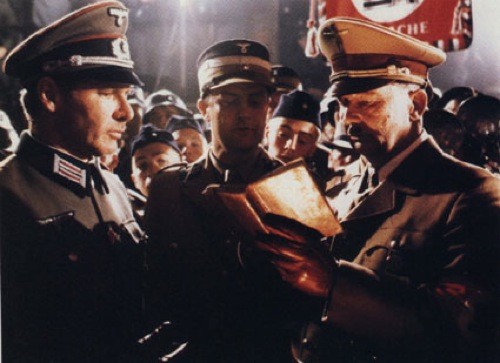
Indiana Jones meets with Hitler in Spielberg’s film
At first sight it seems that the films representing the personality of Hitler and his era have increased by leaps and bounds from the 1990s. Hitler appeared in cameo-roles in adventure films and thrillers (Indiana Jones and the Last Crusade, 1989; Fatherland, 1994 – the latter is a film version of Robert Harris’ allohistorical bestseller about the fictive world of Germany in which the Nazis won WW2), but he also had the leading role in biographical or quasi-biographical films (The Empty Mirror, 1996; Molokh, 1999; Max, 2002; Hitler: The Rise of the Evil, 2003; Der Untergang – The Downfall, 2004), comedies (Mein Führer – Die wirklich wahrste Wahrheit über Adolf Hitler – Mein Führer – The Truly Truest Truth about Adolf Hitler, 2007) and so on.
The most well-known and controversial works of this kind are the American TV mini series Hitler: The Rise of the Evil and the German feature film, Der Untergang. These films represent two periods of Hitler’s life I mentioned earlier: the first is the story of his youth and coming to power, while the second is the representation of his last days and the circumstances of his death. The films have different national background and belong to different genres but it is worth to make a comparison between them, since they point out two main threads of contemporary Hitler-interpretation, and the similarities and differences between them will help us sketch some chief trends of the recent popular Hitler-interpretations.
The Rise of the Evil is a mini series in two parts produced by the Canadian film company Alliance Atlantis and aired first on CBS. It was produced as a high budget historical series with spectacular scenery, monumental scenes, with lot of extras and stars in the leading roles (Robert Carlyle as Hitler, Peter O’Toole Hindenburg etc.). Its theme can be considered risky because of the above mentioned problematic and controversial nature of the Hitler-representations, but two decades ago an American TV-series proved that subjects of this kind would be successful: the NBC’s mini series Holocaust (Marvin J. Chomsky, 1978) proved an outstanding success both in America and in Western Europe. [22] During the production of the Hitler-series there were opinions that emphasized the dangerousness of this subject and the contestable nature of the aim of it. For example a critic of the New York Daily News expressed his worries about „Hollywood […] playing the Nazi card,” while Abraham Foxman, chairman of the Anti-Defamation League (an American organization against the anti-Semitism and racial discriminations) expressed his concern about the shooting of a Hitler-film. As he put it, „we find it very distressing that people would spend talent, time and money to make this man human” [23]. It is apparent that the critics feared the humanization of Hitler or rather a kind of representation that would make Hitler a humanized person who is not dreadful enough. On the other hand the producer of the film, Peter Sussman, emphasized the significance of this kind of humanized representation, since the menace of Hitler’s character and the dangerousness of him can be really expressed only in this way. As he mentioned in an interview, „If we think of evil as an aberration, or Hitler as non-human, it’s very easy to put it in a little container by itself and push it away. What I think is important is that there are other possible Hitlers out there”. [24]
When the series were aired the controversies calmed down, since most of the critics who opposed it earlier changed their view. The Anti-Defamation League had issued a statement in its website saying that the film „teaches a significant lesson of history in a powerful way. Not only does the brilliant portrayal by Robert Carlyle show Hitler for the monster that he was, but the film shows how many times he could have been challenged and wasn’t. It makes us understand how fragile democracy is and how potent evil is”. [25] As the rhetoric of this statement shows, the ADL expressed above all the pragmatic importance of the series, but emphasized this pragmatic advantage by appreciating not only the humanization of Hitler, but also the demonization of him (he appeared as a ‘monster’, an ‘evil’ as the statement expressed it). If we subject the film to a closer examination we see that the intention of the producer was hardly granted, thus the series is scarcely more than the new version of the usual and in many respects cultic representation of Hitler.
The film represents the youth of Hitler from his childhood to the coming to total power and squaring accounts with the SA and his political enemies. Although this story line promises the representation of his ‘progress’, a kind of negative ‘Bildungsroman’, it doesn’t fulfill this trajectory. The childhood and the adolescence can be seen only in the first three minutes of the film (through the credits) showing some widely known commonplaces about his family conditions: the brutality of his father, his affection for his mother, the Jewish doctor who had told him the fatal disease of Hitler’s mother (some psychohistorians regard this event and the doctor’s figure as an early trauma that contributed to the development of Hitler’s anti-Semitism). [26] The real story begins in Vienna, but the place is not important from the viewpoint of the evolution of Hitler’s character, since his personality is given from the very beginning of the film. The work pays scrupulously great attention to make the viewer’s identification with Hitler impossible. The figure is half psychopathic and half demonic, with whom the viewer cannot sympathize, therefore we cannot understand his motives. For example all personal connections of Hitler are unnatural and deformed. In the early parts of the film, where his military servicing in the First World War is dealt with, he has a dog that is „educated” by beating in order to accustom to obedience. He does not have friends, and his ‘lovers’ are only admirers at start and unhappy prisoners of him afterwards. He is evil, as the title reveals it, or to be more precise, he is the evil. His iniquity is almost parallel with the (negative) greatness, since the film represents his career as if it had been built consciously, and his character is a demonic, Richard the Third-like villain, who should have been stopped, but the people of his age were unable to do it because they either did not recognize his dreadfulness or were not strong enough to fight against him. All the main characters around Hitler are one-sided figures: Röhm is a dazzled aggressive soldier, Ludendorff a small-minded general who considers himself a politician, Hindenburg a conservative opportunist, etc.; they cannot be compared to Hitler. His only real enemy is the journalist Fritz Gerlich (Matthew Modine), who takes on the task to fight against the evil with his own journalist devices by himself. Gerlich in the film is only a weak supporting-character whose role embodies the type of the enlightened intellectual who recognizes the danger of Hitler, but as a solitary hero he is incapable to fight against him effectively.
The last scenes of the film represent the complete victory of Hitler. The crosscutting of some parallel events in the final scenes (the execution of Röhm, the death of Gerlich in Dachau and the orations of Hitler), vaguely reminiscent of the last scenes of Coppola’s Godfather (the wedding of Michael and the assassination of his enemies), express the power of evil and the beginning of the dark period of history. The direct contrasts of the parallel shots (the bloodstained glasses of Gerlich that had been sent to his widow versus the exultant oration of the Fuehrer) cannot make the dead journalist a real tragic hero, but only a victim of the powerful evil. The closing shots of The Rise showing the funeral ceremony of Hindenburg is shot completely in the style of Nazi propaganda films, some angles considerably similar to Riefenstahl’s Triumph. This denouement is effective, but the main effect is paradoxical, since it expresses both the evilness and the greatness of Hitler, or to be more precise the dreadful sublimity of his evil character. In a word with this ambivalent representation the film cannot get rid of the cultic status of Hitler, but paradoxically, it rather supports and reinforces it. The complete evil is frightful but sublime too, we cannot completely grasp nor understand it.
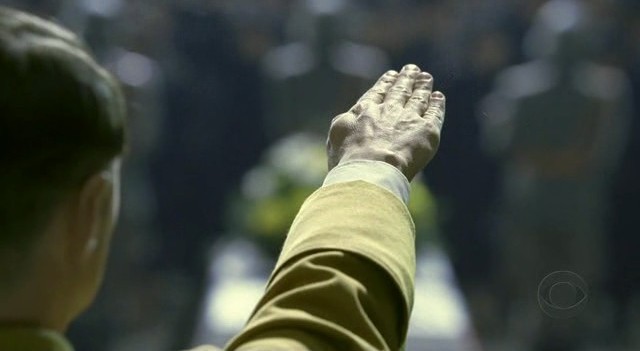
A scene from The Rise
The Untergang is partly based on the memoirs of the secretary of Hitler, Traudl Junge and the book of one of the most significant German historians and biographers of Hitler, Joachim Fest. Both persons had already participated earlier in documentaries on Hitler: Junge acted herself in Im totel Winkel – Hitlers Sekretärin (Blind Spot. Hitler’s Secretary, 2002), and Fest had written and directed the Hitler – eine Karriere (Hitler – a Career, 1977). The director of Untergang, Oliver Hirschbiegel had made a successful thriller Das Experiment (The Experiment, 2001), representing a fictionalized version of the famous Standford prison experiment. This former film of Hirschbiegel may be considered as a preliminary study of the Untergang, since it presents the problem of how ordinary people become fanatical dictators or dreadful killers. The fictional story of the film is a version of the prisoner experiment of the social psychologist Philip Zimbardo that investigated the changes of human behavior in extreme situations like in the position of the prisoner or the guard. Some theorists tried to use the conclusions of this socio-psychological experiment to explain the mechanisms of Nazism and Holocaust. [27]The other film, Der Untergang is a three hour long German movie representing the other above mentioned „myth” of the Hitler-cult: the last days of the Fuehrer and the circumstances of his death. This is not the first feature film treating this topic, but one can find many antecedents to it: Der Letze Akt (dir.: Georg Wilhelm Pabst, 1955), The Death of Adolf Hitler (Rex Firkin, 1973), Hitler: The Last Ten Days (Ennio De Concini, 1973), The Bunker (George Schaefer, 1981), but the Untergang had the highest budget and the greatest success (and controversies) of them all. The producer was Bernd Eichinger, a professional filmmaker who made more than 60 films in different genres, out of which there were European and American blockbusters in almost all popular genres (The Neverending Story, 1984; The Name of the Rose, 1984; Wrongfully Accused, 1998; Resident Evil, 1992 etc.), but especially in the early years of his career some significant works of the new German cinema (for example Falsche Bewegung, dir. by Wim Wenders, 1975). It is worth mentioning that Eichenberg was the producer of one of the most interesting and form-breaking Hitler-films that had been ever made, Hans-Jürgen Syberberg’s Hitler – Ein Film aus Deutschland (Hitler – A Film from Germany, 1977, its commonly known English title is Our Hitler), a Wagnerian-Brechtian Gesamstkunstwerk in seven hours, which deals not only with Hitler as a real, historically situated person, but indeed the Hitler of Germany, or rather with German and European culture in which Hitler (both as a real and symbolical figure) has a great and very specific role. The film of Syberberg, in which Hitler does not appear personally, but in different roles (as Chaplin, a house-painter, the protagonist-variation of Fritz Lang’s film, M etc.) and in form of a marionette puppet, provoked big controversies and a great critical success, but few people have seen it, partly because of its length and its difficult formal and stylistic devices, and partly because the director permitted its screening only in exceptional occasions (like Wagner his operas), emphasizing the special nature of the artistic experience of his film. [28]
The premiere of the film was preceded by a big promotion that mainly consisted of cover stories and interviews in the most popular German newspapers and magazines with the message that this was a film German people had to go and see. The film was well received by the public, it was a real blockbuster in Germany, politicians and public figures emphasized the importance of it in the education of the young people, and many German schools have made it even part of their curriculum. [29] However the reception of it by the experts was quite controversial. Some critics welcomed it enthusiastically (for example the leading British biographer of Hitler, Ian Kershaw had written that he „could not imagine how a film of Hitler’s last days could possibly be better done”), [30] but there were many opposing opinions, too. Most critics raised objections against the presentation of Nazi leaders and Hitler himself, because they are both the protagonists of the film and the victims of the events, thus the audience inevitably identifies with them. For example in the opinion of Hans Mommsen, the doyen of German historians, the film dangerously simplifies the events and the phenomenon of Nazism, since „Reducing history to stories about people is not suitable for gaining an understanding of the greater historical process”. [31] The well-known director Wim Wenders declared more poignantly his aversions: „The film has no opinion about anything, especially not about fascism or Hitler. … Viewers are led into a black hole in which they are (almost) imperceptibly brought to see this area from the point of view of the perpetrators, or at least are asked to bring a certain understanding for them”. [32]
The film as one of the first European feature productions with Hitler in the leading role is addressed above all to the German audience. It can be viewed as part of the tendency in cinema that started more or less in the middle of the 80s (parallel to the above mentioned historical debates and cultural events) that has been trying to work up some past traumatic events from the viewpoint of the Germans – for examplefilms like Stalingrad (Joseph Vilsmaier, 1993) or TV-series like Heimat – Eine deutsche Chronik (Edgar Reitz, 1984 and its two sequels in 1993 and 2004) and Dresden (Roland Suso Richter, 2006) belong to this trend. Thus the main task and problem of the Untergang is showing the dictator to his nation and problematizing both his and his nation’s responsibility for the sins of the Nazi period. Since the film does not deal with the entire life of Hitler or his career, but only the last days of him, it does not show the causes of his coming to power, but only the effects of it. The Untergang not only chooses one event from the entire period that can be represented as a more or less tragic story of downfall, but it also shows it from the viewpoint of the secretary who as a naïve and innocent young girl becomes the metaphor of Germany itself. One can see Hitler with her eyes and her story as a young girl who can be easily deceived, and thus her narrative embodies the story of the whole nation that first was deluded and later on disappointed.
The beginning and closing scenes as framing sections do not show the events of 1945 in the style of feature films but, just like in documentaries, one can see the real old Traudl Junge who comments the past and her role in it from the point of view of her older self. As she says in the introducing scenes, „I feel as if I should be angry with that child, that naïve young girl. Or that I must not forgive her for not recognizing the nature of that monster”. These scenes fulfill two functions: on the one hand they produce an effect of reality („the film is a real story of a real person”) and on the other they designate a point of view, that of a naïve person with whom the audience can identify. This viewpoint is the same through the whole film. At the beginning one can see a scene from 1942 when Junge met Hitler for the first time. Hitler appears here as an engaging gentleman who behaves like a powerful but yielding leader, he is both strict and fair, as Junge would see him at this time, and as the German nation would see him at the peak of his career. However, the following two and half years are missing from the film, and this absence is significant since one cannot see the decline of Hitler, only the last days of his final falling. When we see Hitler again – the film tells us it is the end of April in 1945 – he is already a human wreck whose hands are trembling, a hysterical old man without any sense of reality. The figure of Hitler (played brilliantly by Bruno Ganz) is dreadful and miserable at the same time. He is not a monstrous villain like Carlyle’s Hitler in The Rise, but an insane person who can burst suddenly into rage at any moment and even his own close subordinates cannot rely on his judgments. He is also a miserable disappointed and ill old man, who inevitably evokes little empathy in the spectator. Yet he is not only a miserable but in some sense a sensitive human being, too, who is still capable to love his dog or his wife. This sense of pity is the most problematic elements that had been emphasized by the critics who pointed out the dangerous nature of humanizing Hitler. In my view this is not a fault of the film, on the contrary, it is a way to try to demystify the cultic figure by presenting his human character and showing him not as a symbol of evil but as a man who is similar to us in some respect. In other words the Untergang is successful in avoiding the pitfall of The Rise by pointing out this everydayness of the character and thus emphasizing that Hitler was not the devil himself but in many ways a man just like anyone else.

Hitler in the Untergang
Yet the device of the film that should be mentioned as specifically interesting is not so much the showing of his „humane side”, but the mentioned absence of his decline. We can see only the contrast of the victorious leader and the insane old man. This contrast suggests that people were deluded just like Junge, and the film does not want to point out the causes of the power of Hitler (or does not want to show our Hitler as much Syberberg wanted), but it places the problem outside, to Hitler and his surroundings. At its best moments the film can show some aspects of the essence of Nazism, for example in the scene of the death of Eva Braun’s brother-in-law, Hermann Fegelein (Thomas Kretschmann), who failed to escape and betray Hitler. In his last moments in front of the execution brigade he spontaneously buttons up his uniform salutes and says in his last words „Heil Hitler!”. Scenes like this make possible the insight into the ambivalent character of this period and the working of the system itself: Fegelein is at the same time an opportunist traitor and a German soldier who is incapable of denying his leader in his last moments. The most upsetting moments of the film are not connected to Hitler but indeed to his subordinates. The most shocking scene and one of the culminating points of the film is the assassination of the children of Goebbels by their mother herself who is able to kill her family without a moment of hesitation because she does not want her children to grow up in a world without National Socialism. One can see the death of these children (and later the suicide of Goebbels and his wife) but the death scene of Hitler and Eva Braun is invisible since it happens behind closed doors. It is absent. These missing elements create the essence of the paradoxical representation of Hitler. It cannot explain the enigma of Hitler but it points to this problem with the very absence. At the moment of the fall the essence of the power of Hitler does not appear in himself but in the persons supporting him and in his environment, in a system that works even after his death: in soldiers who are ready to die for him and his ideas and in Berlin falling to pieces. We can see only the dreadful effects of his power, but we cannot get an explanation of it.
Thus this absence gives rise to yet another problem, namely that the characters are divided into some types that can be easily detected. One can recognize the „Nazi Germans” belonging to Hitler and his group, and the „ordinary Germans” who only contemplate the story of falling and suffer because of its effects. This dividedness is noticeable even in the way space is treated in the film. Most of the film takes place in the bunker, a claustrophobic but well-equipped refuge in Berlin. In contrast to it we can see Berlin in ruins and the brutality of the siege. Most of the characters belong either to the world of the bunker or the world of the falling Berlin; the first is an underworld of sinners while the second is a damned land of victims. Some characters can move from one scene to another and they usually move up from below, which can be seen as a process of changing or rather redemption: one subplot is the story of Peter Kranzl (Donevan Gunia), a Hitler youth who meets the Fuehrer in front of the bunker and later on looses his friends, his family and his belief in the Nazi idea. This movement from below to the upper level of Berlin is accomplished by other positive characters, too, like Dr. Schenck (Christian Berkel), the personification of a ‘good German’, who as a doctor struggles against death or Junge, who escapes from the bunker and meets the young Peter at the end of the film. The closing section where Junge and Peter find a bicycle and they cycle out of the ruined Berlin to the green suggests the end of a decline period and the beginning of a new start. The film is not faithful to the real events here, since what happened actually is that the Soviet army arrested Junge and she was held for a year as a prisoner of war. The concluding scene of the Untergang suggests the closing of the Nazi period and a hope of the beginning of new, better times that will be carried out by the young generation. This slightly didactic conclusion is increased by the very last scene in which the older (real) Junge comments on her and the whole nation’s responsibility. She says: „one day, I walked past a commemorative plaque for Sophie Scholl, here on Franz-Joseph Street. I saw that she was my age and that she was executed in the same year I joined Hitler. And only then did I realize that youth is no excuse. And that it might have been possible to find out the truth”. The nation is responsible at least for the passivity that made the Nazi regime possible, but the task of the new generation (of today) is to make amends for the faults (or sins) of the fathers. This has a particular importance if we take into account the didactic-pedagogical aim of the film made in the new age of the reunited Germany by filmmakers who were born after WW2 (Eichinger was born in 1949 and Hirschbiegel in 1957).
With the help of these two brief examples it is perhaps possible to see that recent filmic representations of Hitler and his age have a special relation with the cult of Hitler, or rather with the mythical and symbolic function that he performs in our culture. These films were made with the intention of bringing his figure nearer to us, but I suggest that the main method usually employed means hardly more than the recycling of some clichés and cultic elements that were developed during the Nazi period by the propaganda or counter-propaganda. We can recognize directly the traces of this attitude in The Rise of Evil, which represents the history of this period as if it had been the product of a demonic puppet master who was capable of moving and directing the events and persons of the period, like Dr. Caligari or Mabuse with reference to Kracauer’s famous film history (which in some sense is a result of a Hitler-(anti)cult itself). The demonization of Hitler does not explain his personality or his motives, but it strengthens the cultic character of its figure.
Taking another approach, Untergang tries to apply a humanizing method by showing Hitler as a fallen dictator and it points out his real function in the system that he and his group had brought into existence. It offers a functionalist approach in some respect that emphasizes not only the person but rather the system and the structure of its working. This functionalist representation radically differs from the intentionalist approach of The Rise. (The two terms ‘functionalism’ vs. ‘intentionalism’ are taken from the historiography of Nazism and Holocaust, where the former refers to the historical approaches emphasizing the working of decision-making systems and structures, while the later concentrates on the personal intentions and decisions.) [33] But as we could see, while trying to destroy the cultic representation of Hitler, German film uses some special German cultural narratives, like the opposition between the ‘good’ and the ‘bad Germans’, the myth of the naïve, deluded nation, etc. These myths help to reinforce the identity of the (German) audience, but this method yields only a half solution that is undoubtedly an important step towards deeper, historically more sophisticated new representations.
Given the limitations of this article, I could sketch only a few segments of the complex phenomenon of the cult of Hitler manifested in films. However we have to accomplish a more refined analysis touching on the problem of comic representations, the special national, cultural and political contexts of given films, the cases of extreme ideological presentations, etc. I hope this short survey shows that the problem of the complex relationships between the historical and the filmic cults is a cultural phenomenon in itself, and that the contrastive and comparative analysis focusing on this relationship helps us reach a deeper understanding of our culture and our recent past.
Jegyzetek
- [1] I would like to express my thanks to Imre Bartis and Ákos Seress for their invaluable help in finishing this version of the essay. ↩
- [2] It would be difficult to sketch the connection between saints and the kings (or religious and political cults). Some classical works on this field: Bloch, Marc: The Royal Touch: Sacred Monarchy and Scrofula in England and France. Routledge, London, 1973. (1924.); Kantorowitz, Ernst: The King’s Two Bodies. A Study in Medieval Political Theology. Princeton University Press, Princeton, 1957.; Brown, Peter: The Cult of the Saints. Its Rise and Function in Latin Christianity. Chicago University Press, Chicago, 1981. ↩
- [3] Rosenfeld, Alvin H.: Imagining Hitler. Indiana University Press, Bloomington, 1985. 2. ↩
- [4] Kershaw, Ian: The ‘Hitler Myth’ Image and the Reality in the Third Reich. Oxford University Press, Oxford, 1987. ↩
- [5] About the Hitler-photos see: Kopenick, Lutz: Face/Off. Hitler and the Weimar Photography. In: Finney, Gail (ed.): Visual Culture in Twentieth-century Germany. Text as Spectacle. Indiana University Press, Bloomington, 2006. 214-234. ↩
- [6] Kershaw, 3-4. ↩
- [7] Cf.: Weinberg, David: Approaches to the Study of Film in the Third Reich: A Critical Appraisal. Journal of Contemporary History, 19. (1984/1.) 105-126. (esp.: 107.) ↩
- [8] Welch, David: Propaganda and the German Cinema 1933-1945. I. B. Tauris, London and New York, 2001. 36. ↩
- [9] About the origins of the film, see Kershaw: 69-70. For a thorough and overall analysis of Riefenstahl’s oeuvre and the aesthetic of Nazism, see: Sontag, Susan: Fascinating Fascism. In: Sontag: Under the Sign of Saturn. Essays. Farrar, Straus and Giroux, New York, 2002. (1980.) 73-108. On formal analysis of the Olympia, see: David Bordwell – Kristin Thompson: Film Art: An Introduction. Fifth Edition. The McGraw-Hill Companies, New York, 1997. 132-139. and 368-370. ↩
- [10] Kracauer, Siegfried: From Caligari to Hitler. A Psychological History of the German Film. Princeton University Press, Princeton, 1966. 301. ↩
- [11] Quoted by: Leiser, Erwin: Nazi Cinema. Transl.: Gertrud Mander and David Wilson. Macmillan Publishing Co., New York, 1974. 138. ↩
- [12] Benjamin, Walter: The Work of Art in the Age of Mechanical Reproduction (1936.) ↩
- [13] See: http://www.imdb.com/title/tt0025913/ratings and http://www.imdb.com/title/tt0032653/ratings ↩
- [14] Lukacs, John: The Hitler of History. Random House, New York, 1997. ↩
- [15] On Trevor-Roper’s book, see Rosenfeld: 20-25. ↩
- [16] On the allohistorical works about the survival myth see: Rosenfeld, Gavriel D.: The World Hitler Never Made. Alternate History and the Memory of Nazism. Cambridge University Press, Cambridge, 2005. 199-270. ↩
- [17] See: Renschler, Eric: The Fascination of a Fake: The Hitler Diaries. New German Critique, 90. (2003/Autumn) 177-192. ↩
- [18] http://www.vinilunardelli.com/scelta.html (2008-10-13.) ↩
- [19] Chaplin, Charlie: My Autobiography. Simon & Schuster, New York, 1964. 392. ↩
- [20] Due to the character of this writing I cannot review the more important Hitler-films of the 1960s-1980s. On the English-speaking films of this period see: Macfarlane, Daniel: Projecting Hitler. Representations of Adolf Hitler in English-language Films. ↩
- [21] On the German historian’s debate, see: Forever in the Shadow of Hitler. Original Documents of the Historikerstreit, the Controversy Concerning the Singularity of Holocaust. Humanities Press, New Jersey, 1993. On Bitburg-scandal: Hartman, Geoffrey (ed.): Bitburg in Moral and Political Perspective. Indiana University Press, Bloomington, 1986. About the representational forms: Friedländer, Saul (ed.): Probing the Limit of Representation. Nazism and the „Final Solution”. Harvard University Press, Cambridge, 1992.; Gilman, Sande L.: Is Life Beautiful? Can the Shoah Be Funny? Some Thoughts on Recent and Older Films. Critical Inquiry, 26. (2000/2.) 279-308. ↩
- [22] See Mintz, Alan: Popular Culture and the Shaping of Holocaust Memory in America. University of Washington, Seattle and London, 2001. 23-26. ↩
- [23] Hill, Amelia: Coming to Your Screen Soon: Hitler, the Movie. The Observer, July 21. 2002. ↩
- [24] Interview with Peter Sussman in Judaism – The Jewis Website: http://www.aish.com/jw/s/48891317.html (2009-12-15.) ↩
- [25] http://www.adl.org/PresRele/HolNa_52/4258_52.asp (2009-12-15.) ↩
- [26] See: Waite, Robert G. L.: The Psychopathic God: Adolf Hitler. Da Capo Press, New York, 1993. (1977.) 189. ↩
- [27] See: Bauman, Zygmunt: Modernity and the Holocaust. Polity Press, Cambridge, 2005. (1989.) 151-168. ↩
- [28] There is unfortunately no room to discuss the film of Syberberg in an appropriate manner. On the representational methods and historical view of the film and their problematic nature see: Sontag, Susan: Syberberg’s Hiter. In: Sontag 137-168.; Elsaesser, Thomas: Myth as the Phantasmagoria of History. H. J. Syberberg, Cinema and Representation. New German Critique, 24-25. (1981/Autumn – 1982/Winter) 108-154.; Jameson, Fredrick: „In the destructive element immerse”: Hans-Jürgen Syberberg and Cultural Revolution. In: Jameson: Signatures of the Visible. Routledge, New York & London, 1990. 63-81. ↩
- [29] Bendix, John: Facing Hitler. German Responses to Downfall. German Politics and Society, 25. (2007/1.) 70-89. (See esp.: 78-80.) ↩
- [30] Kershaw, Ian: The Human Hitler. The Guardian, September 17. 2004. ↩
- [31] http://news.bbc.co.uk/2/hi/entertainment/3666076.stm (2009-12-15.) ↩
- [32] Quoted by Bendix: 82. ↩
- [33] See: Mason, Tim: Intention and Explanation. In: Hirschfeld, Gerhard – Kettenacker, Lothar: The ‘Führer State’: Myth and Reality. Studies on the Structure and Politics of the Third Reich. Klett-Kotta, Stuttgart, 1981. 23-40. ↩
Erre a szövegre így hivatkozhat:
Tamás Kisantal: From Triumph to Downfall. Hitler, His Cult, and the Films. Apertúra, 2010. tél. URL:
https://www.apertura.hu/2010/tel/kisantal-from-triumph-to-downfall/